



SizoPIN 200 Tablet

SizoPIN 200 Tablet is an atypical antipsychotic used for managing schizophrenia, particularly in patients who do not respond adequately to other antipsychotic treatments. Clozapine helps regulate neurotransmitters in the brain, reducing hallucinations, delusions, and disorganized thinking, while improving mood and social functioning.

Uses:

  • Treats treatment-resistant schizophrenia

  • Reduces hallucinations and delusions

  • Improves thought processes and mood

Dosage & How to Use:

  • Usually taken once or twice daily, as prescribed by a doctor

  • Swallow whole with water; can be taken with or without food

  • Regular blood monitoring is mandatory due to risk of serious side effects

Precautions:

  • Inform your doctor if you have heart, liver, kidney issues, or seizure history

  • Avoid alcohol and CNS depressants

  • Do not abruptly stop taking clozapine

  • Frequent blood tests are required to monitor white blood cell counts

Side Effects:

  • Drowsiness, dizziness, headache

  • Constipation, weight gain, increased salivation

  • Rarely, serious side effects such as agranulocytosis, seizures, myocarditis, or severe hypotension

SizoPIN 25 Tablet

SizoPIN 25 Tablet is an atypical antipsychotic used to treat schizophrenia, particularly in patients who are resistant to other antipsychotic medications. Clozapine works by modulating certain neurotransmitters in the brain to reduce hallucinations, delusions, and disorganized thinking while improving mood and social functioning.

Uses:

  • Treats treatment-resistant schizophrenia

  • Reduces hallucinations and delusions

  • Improves thought clarity and mood

Dosage & How to Use:

  • Usually taken once or twice daily, as prescribed by a doctor

  • Swallow whole with water; can be taken with or without food

  • Regular blood monitoring is required due to risk of serious side effects

Precautions:

  • Inform your doctor if you have heart, liver, kidney problems, or seizure history

  • Avoid alcohol and other CNS depressants

  • Do not abruptly stop clozapine

  • Frequent blood tests are necessary to monitor white blood cell counts

Side Effects:

  • Drowsiness, dizziness, headache

  • Constipation, weight gain, increased salivation

  • Rarely, serious effects like agranulocytosis, seizures, myocarditis, or severe hypotension

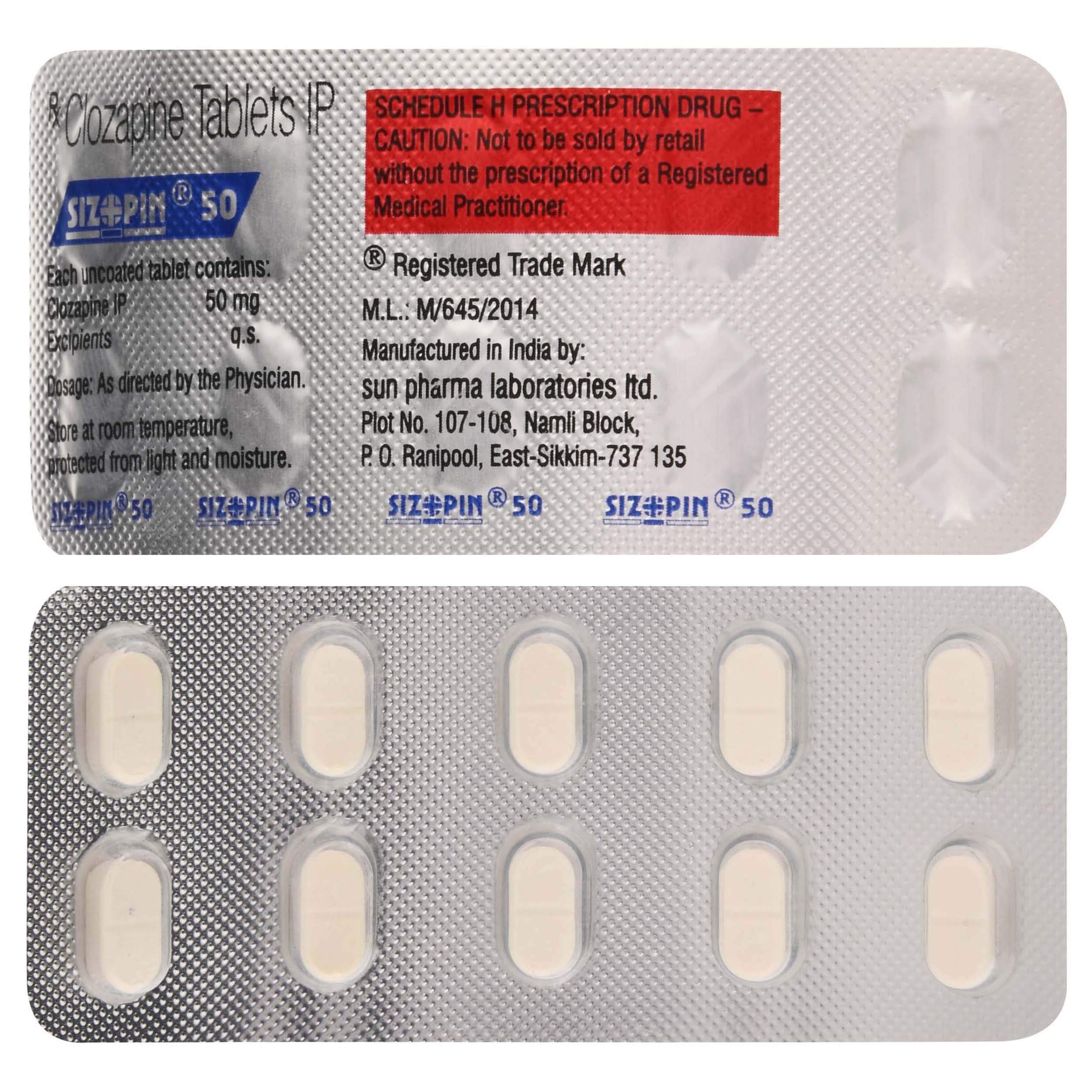
SizoPIN 50 Tablet

SizoPIN 50 Tablet is an atypical antipsychotic used to manage schizophrenia, especially in patients who do not respond adequately to other antipsychotic medications. Clozapine works by regulating neurotransmitters in the brain to reduce hallucinations, delusions, and disorganized thinking, while improving mood and social functioning.

Uses:

  • Treats treatment-resistant schizophrenia

  • Reduces hallucinations and delusions

  • Improves thought clarity and mood

Dosage & How to Use:

  • Typically taken once or twice daily, as prescribed by a doctor

  • Swallow whole with water; can be taken with or without food

  • Regular blood monitoring is essential due to risk of serious side effects

Precautions:

  • Inform your doctor if you have heart, liver, kidney problems, or seizure history

  • Avoid alcohol and CNS depressants

  • Do not abruptly stop taking clozapine

  • Frequent blood tests are required to monitor white blood cell counts

Side Effects:

  • Drowsiness, dizziness, or headache

  • Constipation, weight gain, increased salivation

  • Rarely, serious side effects such as agranulocytosis, seizures, myocarditis, or severe hypotension

SustEN 200 Injection

SustEN 200 Injection contains Natural Micronized Progesterone (100mg/ml), a hormone essential for the regulation of ovulation and menstruation. It is commonly prescribed to treat menstrual irregularities, support pregnancy, and prevent preterm labor in women with low progesterone levels. This injection helps maintain a healthy uterine lining and supports embryo implantation during early pregnancy.

Uses:

  • Management of menstrual disorders due to progesterone deficiency

  • Support of early pregnancy and prevention of miscarriage

  • Assisted reproductive therapy (ART) to enhance implantation success

  • Hormone replacement therapy (HRT) in menopausal women along with estrogen

  • Prevention and treatment of preterm labor

Dosage & How to Use:

  • Administered intramuscularly (IM) or subcutaneously (SC) under medical supervision

  • The dose and frequency are determined by your doctor based on your condition

  • Do not self-administer the injection

  • Follow the schedule as directed to ensure optimal hormonal balance

Precautions:

  • Inform your doctor if you have a history of liver disease, breast or uterine cancer, or unexplained vaginal bleeding

  • Use with caution in patients with cardiac, kidney, or seizure disorders

  • Avoid alcohol and driving after administration if you feel dizzy or drowsy

  • Safe use during pregnancy should be as per medical advice

Side Effects:

  • Pain, redness, or swelling at the injection site

  • Nausea or bloating

  • Breast tenderness or mood changes

  • Drowsiness, headache, or dizziness

SustEN 200 Soft Gelatin Capsule

SustEN 200 Soft Gelatin Capsule contains Natural Micronized Progesterone (200mg), a hormone used to treat and manage conditions caused by low progesterone levels in women. It helps regulate the menstrual cycle, supports early pregnancy, and is prescribed for hormone replacement therapy (HRT) in menopausal women. The medicine plays a vital role in preparing the uterus for pregnancy and maintaining it during the early stages.

Uses:

  • Treatment of progesterone deficiency

  • Regulation of menstrual disorders and amenorrhea

  • Support for pregnancy in women undergoing assisted reproductive therapy (ART)

  • Hormone replacement therapy along with estrogen during menopause

  • Prevention of preterm labor (as advised by a doctor)

Dosage & How to Use:

  • Take this capsule exactly as prescribed by your doctor

  • It can be taken orally with water or vaginally if recommended

  • Do not crush or chew the capsule

  • The dosage and duration depend on your condition and medical response

Precautions:

  • Inform your doctor about any liver disease, heart problems, or unexplained vaginal bleeding

  • Avoid use if you have a history of breast or uterine cancer

  • Use with caution during pregnancy and breastfeeding

  • Avoid alcohol and driving immediately after consumption due to possible drowsiness

Side Effects:

  • Nausea, bloating, or mild abdominal discomfort

  • Breast tenderness or swelling

  • Headache, dizziness, or mood changes

  • Sleepiness or fatigue

Syncapone 100 Tablet

Uses:
Syncapone 100 Tablet is a combination medicine used in the management of Parkinson’s disease, a disorder that affects movement and causes tremors, stiffness, and difficulty in coordination. It contains three active ingredients — Levodopa, Carbidopa, and Entacapone — that work together to restore the balance of dopamine, a chemical messenger in the brain responsible for movement control.

  • Levodopa converts into dopamine to relieve symptoms of Parkinson’s disease.

  • Carbidopa prevents the premature breakdown of Levodopa, allowing more of it to reach the brain.

  • Entacapone prolongs the effect of Levodopa by inhibiting the enzyme COMT.
    This combination helps improve mobility, reduce stiffness, and enhance overall quality of life for patients with Parkinson’s.


How to Use:
Take Syncapone 100 Tablet exactly as prescribed by your doctor. Swallow the tablet whole with a glass of water, preferably with or without food as directed. Avoid crushing or chewing the tablet. Take it at the same time each day for consistent results. Do not stop taking the medicine suddenly without medical advice, as it may worsen your symptoms.


Precautions:

  • Inform your doctor if you have liver disease, kidney problems, heart disorders, low blood pressure, or mental health conditions.

  • Avoid alcohol and sudden position changes, as this medicine may cause dizziness or lightheadedness.

  • Caution is advised while driving or operating machinery since the drug may cause sleepiness or blurred vision.

  • Tell your doctor about all the medicines you are taking, especially antidepressants, antipsychotics, or other Parkinson’s drugs.

  • Pregnant or breastfeeding women should take this medicine only under medical supervision.


Dosage:
The dosage and duration are determined by your doctor based on your health condition and response to therapy. Do not skip doses or take more than prescribed. If you miss a dose, take it as soon as you remember, but skip it if it’s almost time for your next dose.


Side Effects:
Common side effects of Syncapone 100 Tablet include:

  • Nausea or vomiting

  • Dizziness or lightheadedness

  • Sleepiness or fatigue

  • Diarrhea or stomach upset

  • Dry mouth

  • Confusion or hallucinations (in some cases)

  • Change in urine color (dark or reddish-brown, usually harmless)

Seek medical help immediately if you experience severe dizziness, irregular heartbeat, uncontrolled movements, or mental changes.

Syncapone 150 Tablet

Uses:
Syncapone 150 Tablet is a combination formulation indicated for the treatment of Parkinson’s disease and Parkinson’s-like symptoms such as tremors, stiffness, slowness of movement, and loss of coordination. The medicine combines three pharmacological agents:

  • Levodopa: A dopamine precursor that crosses the blood–brain barrier and is converted into dopamine, compensating for dopamine deficiency in the brain.

  • Carbidopa: A peripheral decarboxylase inhibitor that prevents the breakdown of Levodopa before it reaches the central nervous system, enhancing its efficacy and reducing peripheral side effects such as nausea.

  • Entacapone: A catechol-O-methyltransferase (COMT) inhibitor that prolongs the duration of Levodopa’s effect by inhibiting its peripheral metabolism.
    Together, these agents provide improved symptom control and extended “on-time” in Parkinson’s disease management.


How to Use:
Syncapone 150 Tablet should be taken orally, as prescribed by a neurologist or physician experienced in managing Parkinson’s disease. The tablet is to be swallowed whole with water and may be taken with or without food. Dosing intervals and frequency are individualized based on disease severity, previous Levodopa exposure, and patient response. Patients are advised not to discontinue therapy abruptly without medical consultation, as this may result in a rapid return or worsening of Parkinsonian symptoms.


Precautions:

  • Patients with hepatic impairment, cardiovascular disorders, or psychiatric conditions require dose adjustments and monitoring.

  • Orthostatic hypotension may occur; patients should rise slowly from sitting or lying positions.

  • Concurrent use of non-selective monoamine oxidase inhibitors (MAOIs) is contraindicated.

  • Periodic monitoring of liver function, hematological parameters, and renal function is recommended during prolonged therapy.

  • The medicine may cause somnolence; patients should avoid driving or operating heavy machinery until they understand how the medication affects them.

  • Pregnant or lactating women should use this medication only if potential benefits justify potential risks.


Dosage:
The dosage is determined by the prescribing physician based on prior dopaminergic therapy and clinical response. Typically, one tablet is administered several times daily, maintaining consistent dosing intervals. If a dose is missed, it should be taken promptly unless it is near the next scheduled dose. Doubling doses is contraindicated.


Side Effects:
Reported adverse effects include:

  • Nausea, vomiting, and abdominal discomfort

  • Dizziness and orthostatic hypotension

  • Fatigue and somnolence

  • Dyskinesia or involuntary movements

  • Hallucinations or confusion in some patients

  • Diarrhea and change in urine coloration (dark or reddish-brown, non-pathological)

Serious adverse reactions such as severe dyskinesia, hallucinations, or cardiac irregularities require immediate medical evaluation.

Syncapone 50 Tablet

Uses:
Syncapone 50 Tablet is used in the treatment of Parkinson’s disease, a progressive neurological disorder that affects movement, balance, and coordination. It combines three active ingredients that work synergistically to manage symptoms:

  • Levodopa replenishes the brain’s dopamine levels, improving movement and reducing muscle stiffness and tremors.

  • Carbidopa ensures more Levodopa reaches the brain by preventing its breakdown in the bloodstream, reducing side effects such as nausea.

  • Entacapone extends the duration of Levodopa’s action by blocking an enzyme (COMT) that breaks it down, ensuring long-lasting symptom relief.

This triple-action therapy helps improve mobility, coordination, and quality of life in patients with Parkinson’s disease.


How to Use:
Take Syncapone 50 Tablet as prescribed by your doctor. Swallow it whole with a glass of water, with or without food. Try to take it at the same times each day to maintain consistent levels in your blood. Do not crush or chew the tablet. Avoid sudden discontinuation without consulting your doctor, as this may worsen Parkinson’s symptoms or cause withdrawal reactions.


Precautions:

  • Inform your doctor if you have heart disease, liver or kidney disorders, or a history of mental illness.

  • Avoid alcohol and sudden position changes, as this medicine can cause dizziness or a drop in blood pressure.

  • The medicine may cause drowsiness or sudden sleep episodes — avoid driving or operating machinery until you know how it affects you.

  • Do not take this medicine along with non-selective MAO inhibitors (such as phenelzine or tranylcypromine).

  • Pregnant or breastfeeding women should use this medication only if prescribed by a doctor.


Dosage:
Your doctor will decide the correct dose and frequency based on your condition and response to treatment. Usually, one tablet is taken multiple times a day. If you miss a dose, take it as soon as possible, but skip it if it’s close to the next scheduled dose. Do not double up doses.


Side Effects:
Common side effects of Syncapone 50 Tablet include:

  • Nausea or vomiting

  • Dizziness or lightheadedness

  • Drowsiness or fatigue

  • Diarrhea or stomach upset

  • Uncontrolled movements (dyskinesia)

  • Confusion or hallucinations (in rare cases)

  • Change in urine color (dark or reddish-brown, harmless)

Seek medical attention if you experience severe involuntary movements, irregular heartbeat, or mental changes.

Syndopa 110 Tablet

Uses:
Syndopa 110 Tablet is prescribed for Parkinson’s disease and Parkinson’s-like disorders. It combines Levodopa, a dopamine precursor, with Carbidopa, which prevents premature breakdown of Levodopa in the bloodstream. This combination helps restore dopamine levels in the brain, improving movement, reducing stiffness, tremors, and muscle rigidity, and enhancing overall motor control.


How to Use:
Take Syndopa 110 Tablet exactly as prescribed by your doctor. Swallow the tablet whole with water, with or without food. Take it at the same times every day to maintain consistent drug levels. Do not crush or chew the tablet. Sudden discontinuation can worsen symptoms; always follow your doctor’s instructions.


Precautions:

  • Inform your doctor if you have heart, liver, kidney, or mental health problems.

  • Avoid alcohol as it may increase dizziness or drowsiness.

  • Use caution when driving or operating machinery.

  • Do not take with non-selective MAO inhibitors.

  • Pregnant or breastfeeding women should only use under medical supervision.


Dosage:
The dosage depends on your condition and response to treatment. Usually, the tablet is taken multiple times a day as directed by your physician. If a dose is missed, take it as soon as possible unless it is near the next scheduled dose. Do not double doses.


Side Effects:
Common side effects include:

  • Nausea and vomiting

  • Dizziness or lightheadedness

  • Drowsiness or fatigue

  • Dyskinesia (involuntary movements)

  • Confusion or hallucinations in some cases

  • Dark or reddish-brown urine (harmless)

Seek immediate medical attention if severe side effects occur, such as irregular heartbeat, uncontrolled movements, or severe mental changes.

Syndopa 275 Tablet

Uses:
Syndopa 275 Tablet is prescribed for Parkinson’s disease and Parkinson’s-like movement disorders. It contains a combination of Levodopa and Carbidopa that helps restore dopamine levels in the brain. Levodopa alleviates symptoms such as tremors, rigidity, slowness of movement, and balance difficulties, while Carbidopa prevents the premature breakdown of Levodopa in the bloodstream, increasing its effectiveness and reducing side effects like nausea. This combination improves motor function and enhances the quality of life in patients with Parkinson’s disease.


How to Use:
Take Syndopa 275 Tablet exactly as directed by your doctor. Swallow the tablet whole with water, with or without food. Do not crush, chew, or break the tablet. Take it at the same times daily to maintain consistent medication levels. Do not stop the medicine abruptly, as this may worsen Parkinsonian symptoms or cause withdrawal effects.


Precautions:

  • Inform your doctor if you have heart, liver, kidney, or mental health conditions.

  • Avoid alcohol, which may increase dizziness, drowsiness, or low blood pressure.

  • Use caution while driving or operating machinery until you know how the medicine affects you.

  • Do not take this medicine with non-selective MAO inhibitors.

  • Pregnant or breastfeeding women should use this medication only under medical supervision.

  • Report any sudden sleep episodes, mood changes, or unusual movements to your doctor immediately.


Dosage:
Dosage is determined by the prescribing physician based on individual patient needs and response to therapy. Usually, one tablet is taken multiple times a day as directed. If a dose is missed, take it as soon as possible unless it is near the next scheduled dose. Do not double doses.


Side Effects:
Common side effects include:

  • Nausea or vomiting

  • Dizziness or lightheadedness

  • Drowsiness or fatigue

  • Dyskinesia (involuntary movements)

  • Confusion or hallucinations in some cases

  • Dark or reddish-brown urine (harmless)

  • Gastrointestinal discomfort

Seek immediate medical attention if severe side effects occur, such as uncontrolled movements, irregular heartbeat, or severe mental changes.

Syndopa CR Tablet

Uses:
Syndopa CR Tablet is a controlled-release formulation used to manage Parkinson’s disease and Parkinson’s-like movement disorders. It combines Levodopa, which replenishes dopamine in the brain, with Carbidopa, which prevents the premature breakdown of Levodopa in the bloodstream. This combination helps reduce symptoms such as tremors, muscle stiffness, slowness of movement, and balance difficulties. The controlled-release form ensures a sustained release of medication, providing longer symptom relief and reducing the frequency of doses.


How to Use:
Take Syndopa CR Tablet exactly as prescribed by your doctor. Swallow the tablet whole with water; do not crush, chew, or break it, as this can affect the controlled-release mechanism. It may be taken with or without food. Take at the same time each day to maintain consistent blood levels of the medicine. Do not stop therapy abruptly, as this may worsen Parkinsonian symptoms.


Precautions:

  • Inform your doctor if you have heart, liver, kidney, or psychiatric conditions.

  • Avoid alcohol, as it may increase drowsiness or dizziness.

  • Use caution when driving or operating machinery until you know how the medicine affects you.

  • Do not use this medicine with non-selective MAO inhibitors.

  • Pregnant or breastfeeding women should take this medication only under medical supervision.

  • Monitor for sudden sleep episodes or severe mood changes and report them to your doctor.


Dosage:
The dosage is determined by your physician based on your condition and response to treatment. Typically, the tablet is taken once or twice daily, depending on the doctor’s recommendation. If a dose is missed, take it as soon as you remember, but skip it if it is near the next scheduled dose. Do not double doses.


Side Effects:
Common side effects may include:

  • Nausea or vomiting

  • Dizziness, lightheadedness, or drowsiness

  • Dyskinesia (involuntary movements)

  • Confusion, hallucinations, or agitation in some patients

  • Dark or reddish-brown urine (harmless)

  • Gastrointestinal discomfort

Seek immediate medical attention if you experience severe involuntary movements, irregular heartbeat, or significant mental changes.

Tetmosol Dusting Powder

Overview
Tetmosol Dusting Powder is a medicated antifungal powder used to relieve itching, rashes, redness, and irritation associated with fungal infections and prickly heat. Its main ingredient, Clotrimazole, works by stopping the growth of fungus on the skin, while the powder base helps absorb excess sweat and keeps the skin dry and fresh.

Uses
This powder is effective in managing fungal skin conditions such as athlete’s foot, ringworm, and jock itch. It also provides comfort during hot and humid weather by soothing prickly heat and sweat rashes. Regular use can help prevent the recurrence of infections, especially in body folds like underarms, groin, and neck.

How to Use
Before applying, wash and thoroughly dry the affected area. Sprinkle a light layer of the powder evenly on the skin two to three times daily or as advised by a doctor. The powder can also be used inside footwear, socks, or undergarments to reduce fungal growth in sweaty areas. Hands should be washed after use to avoid spreading the infection.

Dosage
Adults can apply the powder two to three times a day. In children, use should only be done under medical guidance. Treatment should continue for a few days even after symptoms improve to prevent the infection from coming back.

Precautions
The powder is strictly for external use only. It should not be applied to open wounds or broken skin unless prescribed by a doctor. Avoid contact with the eyes, nose, and mouth. Pregnant and breastfeeding women should consult a doctor before use. Always store it in a cool and dry place, away from direct sunlight, and keep it out of children’s reach.

Possible Side Effects
Tetmosol Dusting Powder is generally safe to use, but some people may experience mild side effects like irritation, redness, burning, or allergic reactions. If these symptoms persist or worsen, the powder should be discontinued and medical advice should be sought.